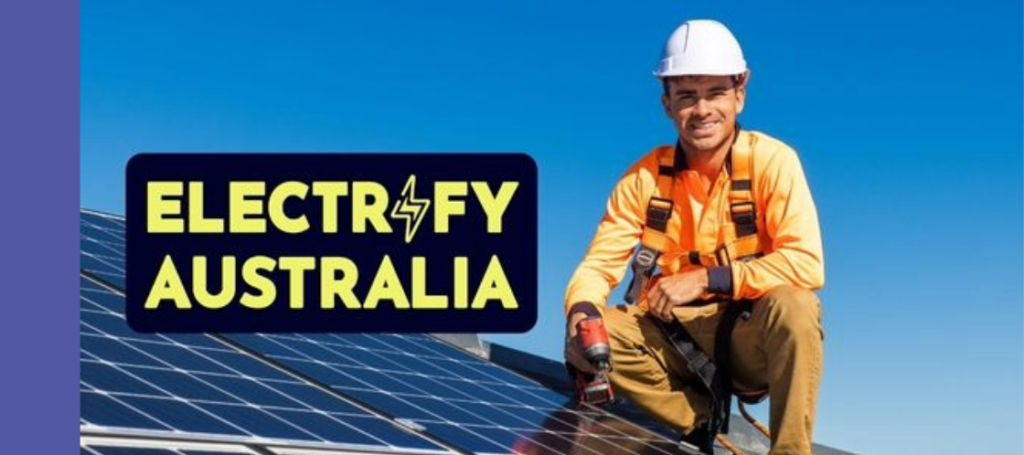
A NSW energy research and innovation network involving the University of Newcastle has joined a national campaign calling for faster electrification across homes, businesses and some of Australia’s largest energy-using sectors.
The NSW Decarbonisation Innovation Hub‘s Electrification and Energy Systems Network is among more than 30 organisations that have signed an open letter to Prime Minister Anthony Albanese and Minister for Climate Change and Energy Chris Bowen as part of the Electrify Australia campaign.
Representatives from participating organisations launched the campaign at Parliament House in Canberra on 14 September.
The campaign is seeking policies, incentives and regulatory changes to make it easier for households and businesses to replace equipment powered by gas, petrol and diesel with electric alternatives powered increasingly by renewable electricity.
Its scope extends beyond household appliances and electric vehicles to agriculture, manufacturing, food processing, freight, commercial buildings, resources and energy.
Energy Efficiency Council chief executive Luke Menzel said Australia’s deployment of renewable generation and storage had created an opportunity to extend electrification into other parts of the economy.
“We’re world leaders at rolling out solar, wind and batteries. Electrification is the final piece of the puzzle that will put all that clean energy to work, by swapping petrol and diesel vehicles with EVs, and replacing gas equipment with efficient, electric alternatives.”
Policy roadmap targets barriers across the economy
The open letter argues that the barriers to electrification differ between households, transport, agriculture, industry, commercial buildings, resources and energy, but that policy changes, regulation and targeted funding could help increase uptake.
Electrify Australia has also developed a policy roadmap containing recommendations for different parts of the economy, including rental properties, manufacturers, food processors, farms and freight.
The campaign argues that electric technologies capable of replacing some uses of gas, petrol and diesel are already available, but that government action is needed to support wider deployment.
Energy Efficiency Council Head of Policy Jeremy Sung said the Federal Government had a role in providing greater certainty about the direction of the energy system.
“There’s a role for the Australian Government to send a clear signal that electrification is happening and that it’s what the future of our energy system will depend on.”
The campaign is also seeking targeted support for people and businesses that currently face barriers to making the switch to electric technologies.
Hunter connected through NSW research network
The involvement of the Electrification and Energy Systems Network provides a direct connection between the national campaign and energy research and industry collaboration involving the Hunter.
The Network is part of the NSW Decarbonisation Innovation Hub and includes the University of Newcastle alongside UNSW, University of Technology Sydney and University of Wollongong. Professor John Fletcher from UNSW is the Network Lead.
Its work focuses on electrification and renewable energy systems, including addressing technical, economic, social and environmental barriers and supporting the development, commercialisation and deployment of technologies.
The University of Newcastle is also a co-host of the wider NSW Decarbonisation Innovation Hub, which brings universities, government and industry together to support the development and deployment of decarbonisation technologies in NSW.
The campaign’s inclusion of manufacturing, resources, transport and energy makes its policy push relevant to the Hunter’s industrial transition, where electrification can involve considerably more than replacing household gas appliances.
Industrial electrification can include replacing equipment and processes currently reliant on fossil fuels with electric alternatives, while electrification of transport can extend from passenger vehicles into freight and other commercial applications.
Energy security added to the case for electrification
Electrify Australia is also presenting electrification as an energy security issue.
The open letter points to Australia’s reliance on imported fuels and argues that greater use of domestically generated electricity could reduce exposure to movements in international fuel prices.
It says Australia imports more than 90 per cent of the diesel used by trucks, mines and farms and argues that electric technologies provide an alternative for some activities currently dependent on imported fuels.
Rather than focusing only on replacing fossil-fuel electricity generation with renewable generation, the campaign is seeking greater use of electricity in activities currently powered directly by gas, petrol and diesel.
More than 30 organisations have backed the campaign, spanning energy, transport, agriculture, consumer advocacy, research, the built environment, unions and environmental groups. Signatories include the Energy Efficiency Council, Clean Energy Council, Energy Consumers Australia, Electric Vehicle Council, Australian Alliance for Energy Productivity, Farmers for Climate Action, Green Building Council of Australia and Rewiring Australia.
Electrify Australia is also part of the international Electrify Now movement, which is seeking to accelerate electrification internationally.