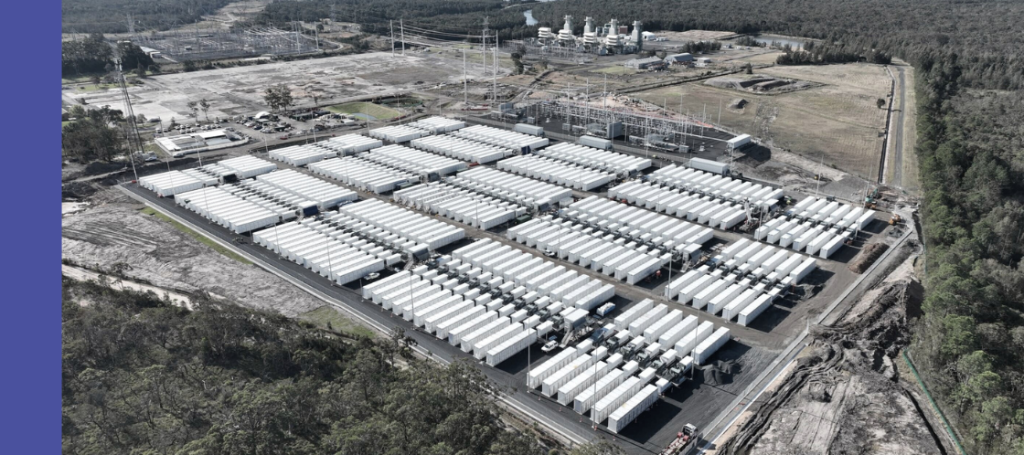
A former coal-fired power station site on the Central Coast is again playing a major role in the NSW electricity system after the Waratah Super Battery reached full operational capacity.
The NSW Government announced on 28 September that the 850 MW, 1,680 MWh battery at Munmorah was operating at full capacity following approval from the Australian Energy Market Operator.
The battery has been built on the site of the former Munmorah Power Station, which operated for more than four decades before closing in 2012.
Rather than generating electricity, the site now provides a different function for the grid, with the battery designed primarily to protect the transmission network from major disruptions.
Up to 700 MW and 1,400 MWh of the battery’s capacity is reserved for that grid-protection role.
Protecting transmission into Newcastle
The Waratah Super Battery is intended to act as a buffer for the electricity system if a major transmission line is disrupted.
It works with a System Integrity Protection Scheme delivered by Transgrid, which monitors the network and can rapidly trigger the battery when required.
That protection allows existing transmission infrastructure to carry more electricity while maintaining system security.
Associated network upgrades have increased the capability of the transmission system supplying major load centres including Newcastle, Sydney and Wollongong.
The project was developed as part of the NSW Government’s response to the closure of the Eraring Power Station, with the battery and associated transmission works intended to provide additional system security as the state’s electricity generation mix changes.
Coal site repurposed for storage
Munmorah Power Station was commissioned in the late 1960s and had four coal-fired generating units with a combined capacity of 1,400 MW.
The station ceased generation in 2012 and was subsequently decommissioned and demolished.
The Waratah project has returned the site to large-scale electricity infrastructure use, taking advantage of a location already connected to the transmission network.
Akaysha Energy was contracted to develop, own and operate the battery, while EnergyCo commissioned the project as part of the NSW Government’s electricity infrastructure program.
Transgrid delivered upgrades to 22 substations and four existing transmission lines, as well as the System Integrity Protection Scheme that monitors the network and can trigger the battery to respond when required.
About 1,000 people were involved in the design and construction of the project, including around 170 workers at the Munmorah site.
Battery reaches full capacity
The Waratah Super Battery began operating at around half of its capacity in August 2025 while commissioning and testing continued.
AEMO has now approved operation at the battery’s full 850 MW capacity.
The remaining capacity not reserved for the battery’s system-protection function can participate in the electricity market, while the contracted portion remains available when required to respond to transmission events.
The move to full operation marks a new phase for the former Munmorah site, more than a decade after coal-fired generation ended there.