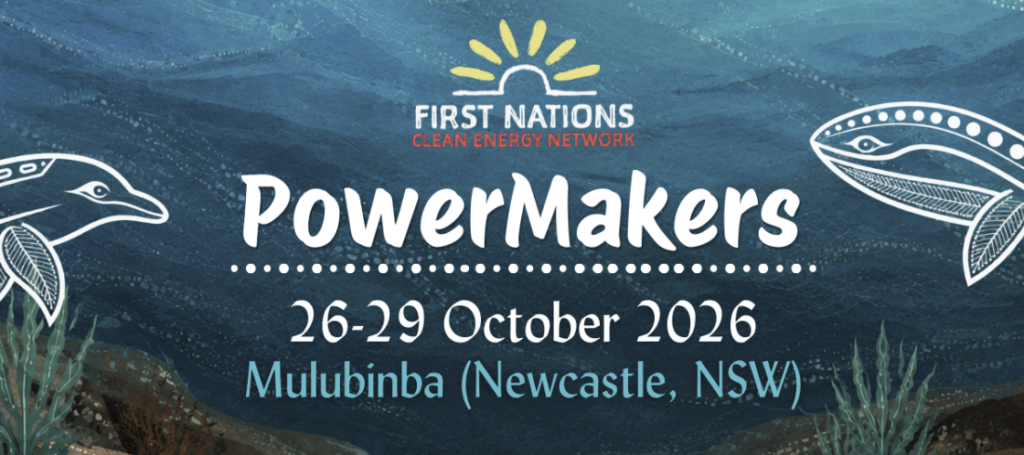
The First Nations Clean Energy Network is holding its fourth PowerMakers program in Mulubinba (Newcastle) from 26 to 29 October 2026, bringing together participants selected from more than 70 applicants.
The program includes representatives from four local Aboriginal organisations: Awabakal Local Aboriginal Land Council, Biraban Local Aboriginal Land Council, Mindaribba Local Aboriginal Land Council and Wonnarua Nation Aboriginal Corporation.
Participants are examining how First Nations communities can develop their own renewable energy projects, negotiate agreements with energy developers and secure lasting economic benefits from projects on Country.
The program also addresses household energy costs and access to clean energy, including rooftop solar, batteries, energy efficiency improvements and the barriers faced by renters and social housing tenants.
Following a Welcome to Country and Smoking Ceremony by Traditional Owners on 26 October, participants are undertaking three days of workshops and discussions with First Nations clean energy leaders, industry experts and other participants.
The Mulubinba program includes visits to CSIRO’s Energy Centre and the Murrook Cultural Centre on Worimi Country at Williamtown.
First Nations Clean Energy Network Director Bec Halliday said participants were already involved in a range of clean energy activities.
“They’re leading renewable energy development projects, collaborating with neighbour Nations for better outcomes, and negotiating large-scale benefit-sharing and a seat at the table for projects on Country.”
Building First Nations leadership since 2021
The First Nations Clean Energy Network was established in 2021 to increase First Nations participation in Australia’s renewable energy transition and ensure communities share in the economic benefits.
The Network brings together First Nations people, community organisations, land councils, unions, researchers, legal and technical advisers, industry groups and renewable energy companies.
Its work includes advocating for First Nations rights in energy development, supporting community-led projects and providing information and resources to help communities negotiate with project developers.
In 2024, the Network contributed to the development of the Leading Practice Principles: First Nations and Renewable Energy Projects, produced by the Clean Energy Council and KPMG in collaboration with First Nations and industry representatives.
The guide provides advice for renewable energy developers on engagement, participation, benefit-sharing and working with First Nations communities throughout the life of a project.
The Network established PowerMakers in 2023, working with Canada’s Indigenous Clean Energy organisation.
The inaugural program was held in Cairns, Queensland, and brought together 32 First Nations participants.
The collaboration drew on Canadian experience, where Indigenous communities have developed ownership and partnership arrangements for renewable energy projects over several decades.
Since its Australian launch, PowerMakers has been delivered annually, with almost 100 First Nations leaders completing the program before the 2026 intake.
The program combines technical knowledge about renewable energy with practical training in project development, business management, financing, negotiations and cultural governance.
Participants also join a national network of PowerMakers alumni who are working on clean energy opportunities in their communities.
Investment partnership to support First Nations-led projects
The Newcastle gathering follows the announcement of a partnership between the First Nations Clean Energy Network and the Four Directions Fund (4DF) on 20 October.
The partnership aims to advance up to five First Nations-led renewable energy projects across Australia.
Established earlier in 2026, the Four Directions Fund focuses on providing support during the early stages of renewable energy development, when projects can face difficulties securing finance.
The Fund identifies access to capital, trust between project partners, ownership arrangements and the complexity of electricity networks and planning approvals as barriers to Indigenous-led renewable energy development.
Its stated aim is to help First Nations rights-holders and landowners enter renewable energy projects as owners and partners, rather than participating solely through consultation or community benefit arrangements.
The Fund is seeking at least 10 per cent Indigenous ownership in renewable energy projects developed on Indigenous lands.
By 2029, it aims to help bring one gigawatt of renewable energy projects to ready-to-build status across Australia, New Zealand and the United States, with a longer-term ambition of two gigawatts.
These are the Fund’s objectives, rather than projects or investment outcomes already secured.
“Clean power is only part of the story,” Four Directions Fund Co-Founder Kiri Allan said.
“Indigenous communities must hold a genuine ownership stake in the energy future we’re building. Because the energy transition must be clean, it must also be inclusive, equitable and Indigenous-led.”
The partnership with the First Nations Clean Energy Network has not yet identified the five potential Australian projects or confirmed individual funding commitments.
Federal funding supports First Nations clean energy development
The Australian Government is also providing funding to help First Nations organisations participate in and develop clean energy projects.
Its $70 million First Nations Clean Energy Program is being delivered over three years from 2025 as part of the implementation of the national First Nations Clean Energy Strategy, launched in December 2024.
The strategy focuses on improving access to affordable clean energy, supporting equitable partnerships and increasing the economic benefits First Nations people receive from renewable energy development.
The program includes Advice Grants, Pilot Grants and a Clean Energy Toolkit.
The Advice Grants stream provides funding for eligible First Nations organisations to obtain professional advice, undertake planning and develop the knowledge needed to assess clean energy opportunities.
The Australian Government has allocated $39 million over three years to this stream, with grants of $5,000 to $80,000 offered in the first round.
The Pilot Grants stream supports more advanced projects, helping First Nations organisations move beyond feasibility studies towards investment and financial close.
Grants of $1 million to $10 million were offered for eligible activities including engineering design, construction planning, commercial negotiations and community benefit planning.
The pilot funding round was designed to support up to two First Nations organisations and build evidence about the conditions needed to attract investment into First Nations-led clean energy projects.
Applications for the first Advice Grants round and the Pilot Grants round have closed.
The Clean Energy Toolkit is intended to provide information and resources to support First Nations organisations and communities in making informed decisions about clean energy development.
Together, the federal initiatives and the Four Directions Fund partnership address different stages of project development, from accessing independent advice and building community capability to preparing projects for investment.
Hunter organisations take part in national program
The PowerMakers gathering brings local Aboriginal organisations into discussions with First Nations project leaders and energy specialists from across Australia.
The region’s representatives include people working in land councils and community organisations across Newcastle, Lake Macquarie, Maitland and the Upper Hunter.
Their participation comes as renewable energy generation, transmission infrastructure and industrial developments continue to change the Hunter’s energy sector.
Through PowerMakers, participants are examining how First Nations organisations can assess project opportunities, negotiate agreements, develop community-owned energy systems and pursue longer-term financial participation in renewable energy projects.