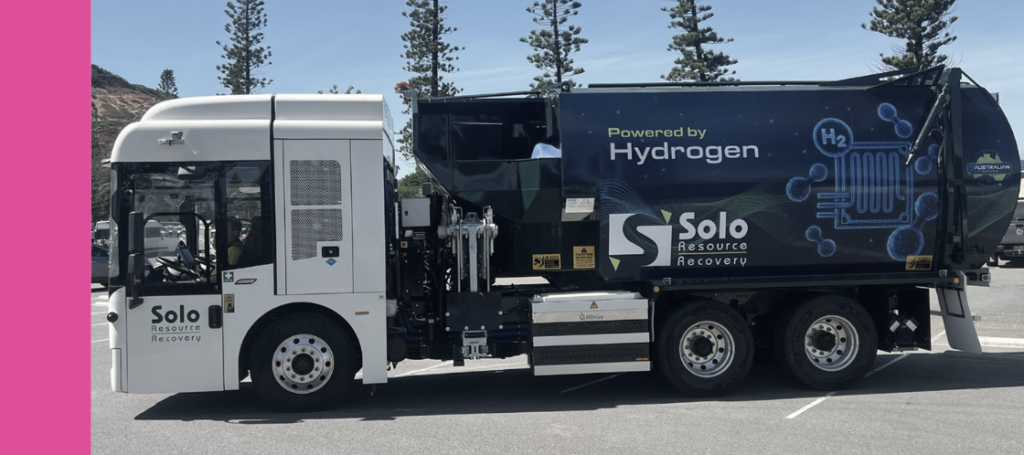
Australian clean technology company Pure One Corporation has confirmed the deployment of two hydrogen fuel cell waste collection trucks in partnership with Solo Resource Recovery, extending an existing collaboration into kerbside recycling services across the Hunter.
The vehicles are being trialled as part of Solo’s contracted recycling collection services for Cessnock, Maitland, Singleton and Lake Macquarie, with a focus on collecting co-mingled recycling from household bins.
According to Pure One’s 15 October announcement, a hydrogen fuel cell side loader and rear loader were scheduled to operate in the region from mid-October until the end of December 2026.
The company reported that both trucks had been displayed at Lake Macquarie’s Living Smart Festival in September before commencing operations in the Hunter in mid-October.
The side loader uses a TG23-H110 dual-control chassis fitted with a compaction body manufactured by Rico Recovery Systems, Solo’s vehicle manufacturing division.
The deployment will allow Solo to examine hydrogen fuel cell technology in established collection services, where vehicles must repeatedly stop, lift bins and compact recycling materials while travelling between collection points.
Solo National Fleet Manager Mark Taylor said the company was continuing its work investigating alternative technologies for the waste industry.
“Solo has always seen innovation as a core part of our long involvement in the Waste Industry. These evaluation trials represent practical and real progress towards a realistic and achievable circular economy.”
Testing hydrogen in everyday waste collection
Hydrogen fuel cell vehicles generate electricity through a chemical reaction between hydrogen and oxygen, which powers an electric drivetrain.
Unlike conventional diesel trucks, fuel cell vehicles produce no carbon dioxide at the tailpipe. Their fuel cells produce water and heat during operation.
However, the overall emissions associated with hydrogen-powered transport also depend on how the hydrogen is produced, transported and supplied.
The companies have not specified the hydrogen source or refuelling arrangements for the Hunter vehicles in their October announcement.
Pure One says the trial will provide operational experience in municipal waste collection, where vehicle reliability, operating efficiency and compatibility with existing services are important considerations.
Pure One Managing Director Scott Brown said:
“Council waste collection is an important market for heavy vehicle technology, with demanding daily operating requirements. Our vehicle trial with Solo provides an opportunity to demonstrate their capabilities in real-world conditions and establish an operational track record that can support future commercial opportunities.”
The company has not released performance results from the Hunter deployment or a detailed methodology for assessing the vehicles.
Building on an earlier hydrogen truck trial
The Hunter deployment follows an earlier hydrogen fuel cell waste collection trial involving Solo and Pure One, previously known as Pure Hydrogen Corporation.
In August 2023, Pure Hydrogen announced an agreement to supply Solo with a hydrogen-powered waste collection vehicle for a six-month evaluation, initially proposed for northern NSW.
The agreement provided for hydrogen supply and maintenance services, with options for further deployment depending on the outcome.
In December 2025, Solo began trialling a hydrogen fuel cell rear-loading truck for Byron Shire Council.
The vehicle was deployed to collect rubbish from public areas around Byron Bay, including the town centre, parks and reserves.
Byron Shire Council said the trial would provide information about the vehicle’s range and performance to help inform future decisions about alternatives to diesel-powered waste trucks.
The Hunter deployment extends that work into household kerbside recycling, using a side-loading truck designed for domestic bin collection alongside a rear-loading vehicle.
Assessing the technology for future fleets
Pure One supplies hydrogen fuel cell and battery-electric commercial vehicles and is developing applications for heavy transport operators.
The company says its work with Solo forms part of its commercial vehicle deployment program, which also includes a hydrogen truck supplied to Heidelberg Materials.
For waste collection operators, hydrogen fuel cell technology offers a potential alternative to diesel-powered vehicles while retaining the specialised lifting and compaction equipment required for municipal services.
However, the suitability of hydrogen trucks for wider fleet deployment will depend on their operational performance, reliability, fuel supply arrangements and costs.
Pure One says the Hunter trial will provide experience with the technology under established municipal operating conditions, with decisions about future vehicle deployments to be made following the trial period.