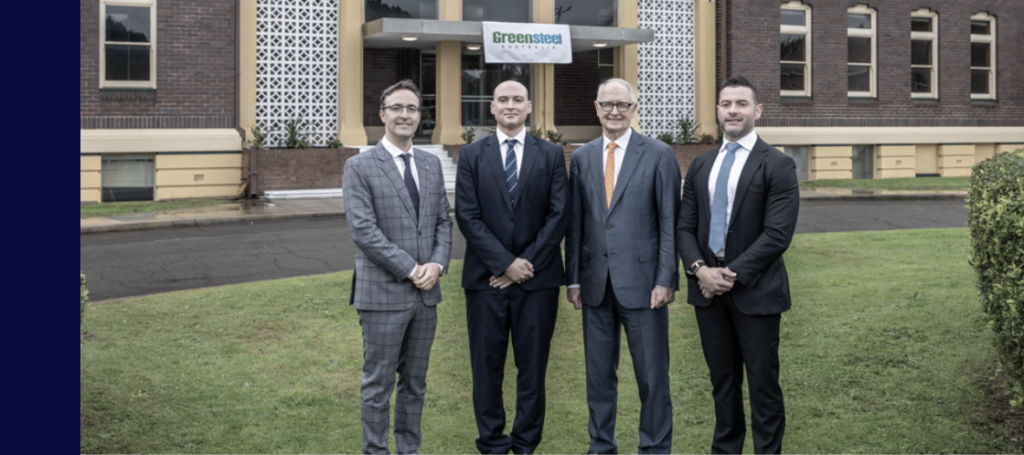
Professor Ross Garnaut AC will deliver the keynote address at the 2026 Hunter Innovation Festival at NEX Newcastle on Tuesday 24 November.
Garnaut, Chair of Greensteel Australia‘s Advisory Group, will discuss the role renewable energy could play in Australian manufacturing, including the company’s plans to establish an electric steel mill at Mayfield North.
Following the keynote, attendees will have an opportunity to put questions to Garnaut and Greensteel Australia Head of Government Relations Patrick Buchan during a main-stage discussion.
The event will give Hunter manufacturers, suppliers, researchers and residents an opportunity to hear directly from those involved in the proposed development, including how the company intends to produce steel without gas-fired heating and its plans to secure renewable electricity.
The discussion comes as Australian companies pursue different approaches to lower-emissions steel production, while new research examines the costs, technologies and markets that could determine the industry’s future.
Plans to return steel manufacturing to Mayfield
In July, Greensteel Australia announced it had secured a 70,000-square-metre site at 51 Industrial Drive, Mayfield North, formerly part of the BHP Newcastle Steelworks.
The company plans to invest $500 million in an all-electric mill capable of producing up to 600,000 tonnes of finished steel annually for Australia’s housing, transport and energy sectors.
Reinforcing bar will be the first product, with wire rod and coil planned for future stages.
According to Greensteel Australia, the initial facility will use electric induction furnace technology supplied by Italian steel equipment manufacturer Danieli, replacing gas-fired heating with electricity.
The proposed operation will focus on processing steel into finished products rather than producing iron directly from iron ore. The company has also outlined longer-term ambitions involving hydrogen-based direct reduced iron and electric arc furnace steelmaking, which would represent additional stages of production.
Greensteel Australia states that its initial process will produce no direct carbon dioxide emissions from gas combustion. However, the overall emissions associated with the finished products will also depend on the electricity and steel feedstock used.
The company expects refurbishment and modernisation work to begin before the end of 2026, with major equipment scheduled to arrive from October 2027. It has nominated January 2028 as its target for commencing operations.
Greensteel Australia forecasts more than 200 direct full-time jobs, including positions for fitters, electricians, crane drivers, metallurgists and engineers, alongside construction employment and opportunities for Hunter suppliers.
“Every tonne of steel we forge at Mayfield is a tonne Australia doesn’t have to import,” Greensteel Australia Chairman Ross Garnaut said in the July announcement.
“That means more reliable supply and better prices for builders, and because there is no gas anywhere in our process, it also means lower embodied carbon in the homes and infrastructure this country needs. That’s a win for builders and home buyers, and a win for the Hunter.”
Renewable energy and battery storage plans
The Mayfield proposal is also linked to plans for renewable electricity supply and energy storage.
In May, Greensteel Australia announced a partnership agreement with ZEBRE Pty Ltd, backed by Taiwan-listed HD Renewable Energy, to investigate renewable electricity supply, energy firming and battery storage solutions for its future Australian operations.
Under the agreement, the companies will explore large-scale renewable electricity supply, behind-the-meter storage and power management systems.
ZEBRE’s portfolio includes 437 MW of renewable energy projects in South Australia, together with battery storage and dispatch capabilities.
The parties are also considering a potential 400 MW large-scale battery system integrated with behind-the-meter storage and power management technology.
Greensteel Australia said discussions would continue towards a definitive commercial agreement, with opportunities to expand renewable energy supply and storage capacity also under consideration.
Western Australian project secures renewable electricity agreement
A separate development in Western Australia illustrates another approach to securing renewable electricity for future steel production.
Generation Steel has announced a binding power purchase agreement with BHP to support the renewable electricity requirements of its proposed steel mill at Collie.
According to Generation Steel, the agreement will provide electricity from operating solar and wind generation sources.
The company intends to operate the proposed facility using renewable electricity from the outset, although commercial production has not commenced.
“I am most proud of how our teams have worked together to convert surplus renewable energy into opportunities that support the wider community and economy,” BHP WA Nickel Manager Commercial Energy and Utilities Rob Whitham said.
While Generation Steel has announced a binding power purchase agreement, Greensteel Australia and ZEBRE are continuing discussions towards a definitive commercial arrangement.
Both developments demonstrate the importance companies are placing on electricity supply as they plan new steel manufacturing facilities.
Government support and the cost of green steel
The opportunities currently associated with lower-emissions steel production are accompanied by substantial technical and financial challenges, with advocates suggesting intervention is necessary.
In a 29 September article published by the Grattan Institute, energy and climate change specialist Tony Wood examined the proposed transition of South Australia’s Whyalla Steelworks towards lower-emissions production.
Wood argued that Australia has advantages in iron ore resources and renewable electricity, but developing an integrated green iron and steel industry would require substantial investment and continued government support.
The proposed Whyalla transition involves several stages, beginning with an electric arc furnace to process recycled steel, followed by direct reduced iron production and the eventual use of hydrogen produced from renewable electricity.
Unlike the initial Mayfield development, this would involve producing iron from iron ore as well as manufacturing steel.
Wood identified the costs of new infrastructure, the development of hydrogen production and uncertainty around future demand as challenges facing the industry.
He argued that government support through the Future Made in Australia program could help establish domestic green iron and steel production, provided investment decisions were accompanied by appropriate oversight.
The analysis also acknowledged that commercial success is not guaranteed, even where Australia has access to the mineral resources and renewable electricity needed for production.
Australia’s changing iron ore markets
The Institute for Energy Economics and Financial Analysis (IEEFA) has also examined how changing international steel demand could affect Australia’s opportunities to produce green iron.
In its 15 October report, titled Green iron exports: Australia must look beyond China, IEEFA noted that approximately 80 to 85 per cent of Australian iron ore is exported to China, where crude steel production peaked in 2020.
The report cited Australian Government forecasts showing iron ore export earnings declining from $123 billion in 2025–26 to $79 billion in 2030–31, reflecting expected changes in prices and volumes.
IEEFA lead analyst Simon Nicholas argued that processing more iron ore domestically could provide an opportunity for Australia to retain greater value from its mineral resources.
However, the report cautioned that China may not become Australia’s principal green iron export market, given its own investments in renewable energy, hydrogen and steel production technologies.
Instead, IEEFA identified opportunities in Japan and South Korea, alongside growing steel demand in India and Southeast Asia.
The research concerns Australia’s broader iron ore and ironmaking industries rather than the initial Mayfield project, which is focused on finished steel products.
Electrification across the steel industry
A second IEEFA report, titled Electrification across the steel value chain, published on 22 October, examined how replacing fossil fuels with electricity could reduce emissions across different stages of steel production.
The research found that electricity currently accounts for less than 12 per cent of the steel sector’s total energy consumption, with substantial opportunities to electrify industrial heating processes.
IEEFA energy finance analyst Soroush Basirat examined technologies including electric arc furnaces and electric heating, as well as the role of hydrogen in ironmaking.
The report distinguished between using hydrogen to remove oxygen from iron ore and using electricity directly to generate industrial heat.
IEEFA found that hydrogen could play an important role as a reducing agent in ironmaking, but direct electrification may be more efficient for heating applications.
The research also identified opportunities for steel manufacturers to manage electricity consumption around periods of lower-cost power, although this would depend on the flexibility of their operations.
Hear directly from Greensteel Australia
For the Hunter, the debate about green steel is no longer just about what might be possible. With a $500 million electric steel mill proposed for the former BHP site at Mayfield, the region has a direct interest in how these technologies develop, whether they can compete commercially and what they could mean for local manufacturing.
The Hunter Innovation Festival will give businesses, researchers and residents a chance to take those questions directly to Ross Garnaut and Greensteel Australia, and hear how the company’s plans fit into Australia’s changing steel industry.
The keynote and discussion will take place on Tuesday 24 November 2026 at NEX Newcastle.