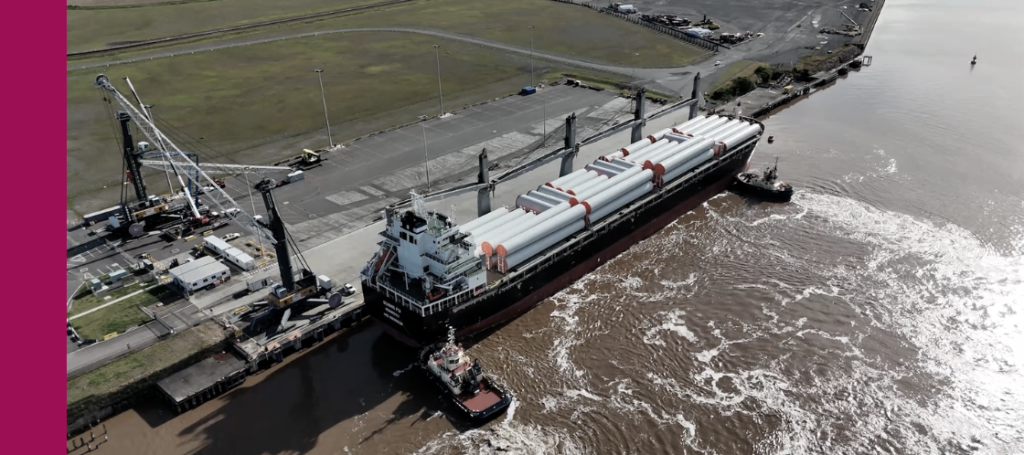
Work has commenced on a waterside berth extension at the Multipurpose Terminal (MPT) at the Port of Newcastle in Mayfield. The project will extend the berth to accommodate vessels up to 300 metres in length, compared with the previous limit of 220 metres.
The contract has been awarded to Australian-based Brady Marine and Civil. Construction is expected to take around 15 months, subject to weather conditions, and is anticipated to create about 30 jobs, including specialised roles such as underwater divers.
Expanding capacity for oversized cargo
The berth extension is designed to improve the Port’s ability to handle large and heavy cargo linked to major infrastructure and energy projects across New South Wales.
The upgrade builds on earlier investment at the terminal, including the installation of two Liebherr LHM 550 cranes in 2022, which are used for handling wind turbine components, containers and other project cargo such as batteries.
With larger vessels able to dock, the terminal is positioned to manage increasing volumes of oversized equipment required for energy and industrial developments.
Linking the Port to renewable energy supply chains
Port of Newcastle CEO Craig Carmody said the project supports the Port’s broader plan to diversify trade and strengthen supply chains.
“We’ve been clear that trade diversification is a key strategic objective for PON and this is a vision that is shared and supported by our partners, our stakeholders, and our community,” Mr Carmody said.
The Port plays a central role in moving equipment for renewable energy projects. According to Mr Carmody, the Port handles the majority of oversized cargo for wind farm developments across the state.
“The importance of the Port of Newcastle in Australia’s energy future cannot be overstated. We are the entry point for the oversized over mass cargo of every single project within the Central West Orana Renewable Energy Zone and over 90% of all wind farm projects across NSW,” he said.
A changing role for the Hunter’s export gateway
The berth extension reflects a shift in how the Port is used, with increasing volumes of imported components supporting energy infrastructure development alongside its long-standing export role.
Mr Carmody said the Port’s function is evolving as new energy projects scale up, noting that infrastructure upgrades are tied to future trade demand.
“For 25 years, the Port has been Australia’s leading exporter of energy to Asia. Now, we have also become the main gateway for importing the components that will power the next phase of our nation’s energy transition.”
The works at Mayfield sit within this transition, with the terminal acting as a logistics point between manufacturing, shipping and inland construction activity.
Local work and regional flow-on effects
The project is expected to generate direct employment during construction, with additional flow-on activity linked to supply chains and project delivery.
By enabling larger vessels and increasing cargo throughput, the extension supports ongoing construction across renewable energy zones and infrastructure projects that rely on port access.
For the Hunter, the upgrade reinforces the Port’s position as a key entry point for equipment moving into regional New South Wales, linking coastal infrastructure with inland energy development.