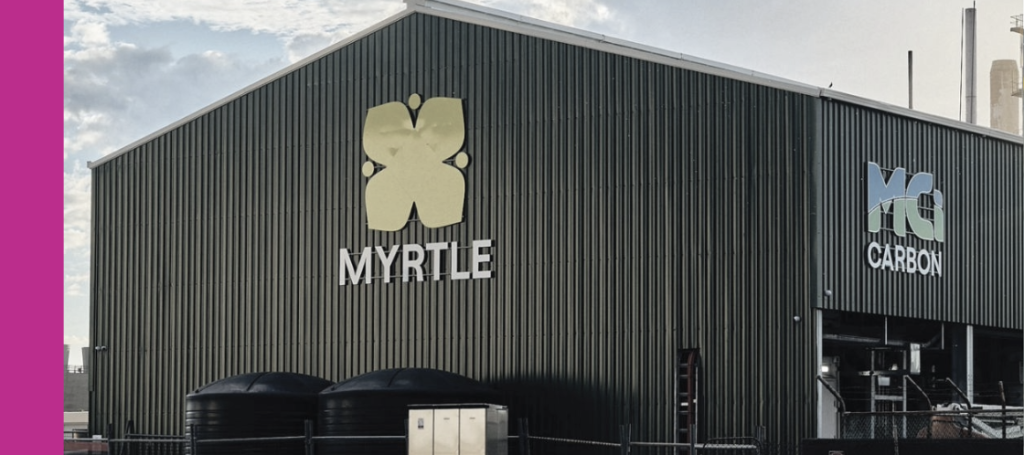
Australian clean technology company MCi Carbon has officially opened Myrtle on Kooragang Island in Newcastle, a facility designed to convert carbon dioxide and mineral feedstocks into materials used in products such as concrete, plasterboard, glass, paint and paper.
The refinery is the result of 15 years of research and development and is intended to provide industrial businesses with a way to assess how their own emissions streams and feedstocks could be used to produce commercial products. According to MCi Carbon, the technology has the potential to reduce net emissions in hard-to-abate industries by up to 90 per cent while generating saleable materials.
Australia’s Minister for Climate Change and Energy, Chris Bowen, officially opened the facility on 17 June, describing it as an example of how industrial regions can participate in Australia’s lower-emissions economy.
Turning carbon into products
MCi Carbon’s process uses mineral carbonation, a low-pressure, low-energy chemical reaction in which carbon dioxide reacts with mineral-rich materials such as steel slag and waste rock to create stable carbonates. The company says the process permanently locks carbon into the resulting materials and produces no waste.
Unlike technologies designed around a single input and output, Myrtle has been developed to accept a range of carbon dioxide streams and mineral feedstocks while producing multiple product types. The platform can be deployed directly at industrial sites or operated from a central facility serving multiple emitters across a region.
MCi Carbon founder and chief executive Marcus Dawe said the facility provides companies with the information required to assess commercial deployment.
“Heavy industry now has a commercial pathway to decarbonise – and profit while doing so. By transforming CO₂ and low-value mineral feedstocks into carbon-embodied materials that cement, steel, plastics, glass and construction industries already buy, MCi Carbon’s mineral carbonation platform reframes decarbonisation as an investment with a return, not a cost to be managed.”
Built to test commercial applications
The facility is hosted at Orica’s Kooragang Island ammonia plant, where carbon dioxide from the site is supplied to Myrtle as part of an example of direct industrial integration. The refinery is capable of processing up to 2,500 tonnes of carbon dioxide annually and producing up to 10,000 tonnes of material.
MCi Carbon says Myrtle’s role extends beyond product manufacturing. The facility is intended to generate operational, technical and commercial data for industrial customers and financiers before larger-scale projects proceed to investment decisions.
The company reports that the platform is designed to scale to facilities capable of processing hundreds of thousands of tonnes of carbon dioxide each year, with materials feeding directly into existing industrial supply chains.
Government and industry backing
MCi Carbon has received more than $40 million in government funding through federal and NSW programs, including support through the Carbon Capture Technologies Program and the CCUS Development Fund. A further $40 million has been raised from private investors including Orica, ITOCHU Corporation, Mizuho Bank, Sumitomo Mitsui Trust Bank, Mitsubishi UBE Cement Corporation and RHI Magnesita.
Minister Bowen said the project demonstrated how industrial emissions could be repurposed into useful products.
“This demonstration plant is a glimpse of what could become a major new industry for places like Newcastle and the Hunter,” Minister Bowen said.
Taking carbon dioxide from industrial production and turning it into materials for homes, buildings and manufacturing is exactly the kind of practical, Australian-made technology we should be backing. This is about cutting emissions, creating new products, and building new clean industries, literally brick by brick.”
Commercial projects already under assessment
Myrtle is currently undertaking its first commercial validation campaign with Austrian refractory products manufacturer RHI Magnesita, which has invested more than USD $10 million in the technology. The companies are working towards a proposed commercial facility in Austria by 2030, with an initial capacity to absorb 50,000 tonnes of carbon dioxide each year while producing more than 200,000 tonnes of mineral products.
The technology is also being assessed internationally. Mitsubishi UBE Cement Corporation has invested in MCi Carbon and entered an agreement with ITOCHU Corporation to evaluate its application within Japanese operations. In Australia, materials produced at Myrtle have already been tested in concrete trials conducted through a project involving Boral, SmartCrete CRC, Transport for NSW and the University of Technology Sydney. Initial results showed performance comparable with conventional cementitious inputs under commercial batching conditions.
Located alongside major manufacturing and export infrastructure, Myrtle places another industrial-scale clean technology project within Newcastle’s growing network of facilities focused on emissions reduction, advanced materials and industrial innovation.