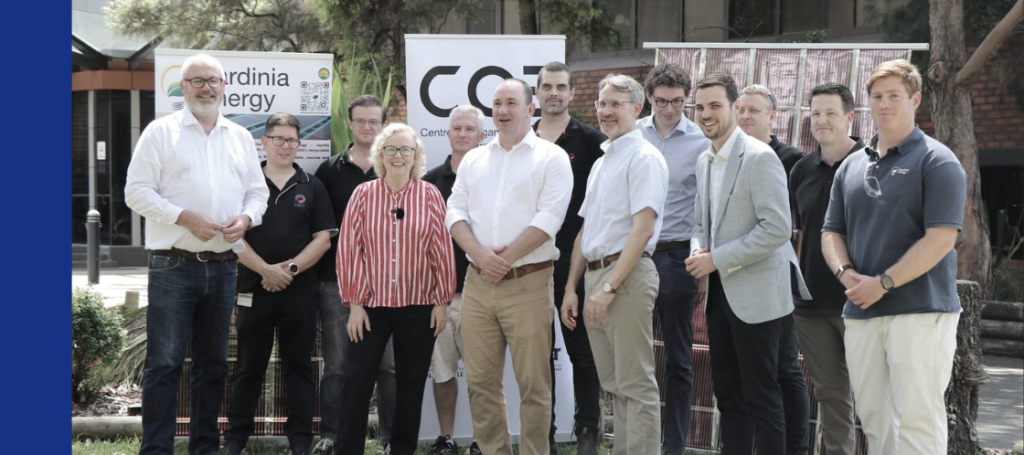
Kardinia Energy has secured $2.15 million through the Australian Government’s Industry Growth Program to support the next stage of its flexible printed solar technology.
The company designs and manufactures the technology in Newcastle, with the funding intended to assist its move toward commercial production. Kardinia Energy said the investment will help advance the scale-up of its printed solar, which is positioned as a low-cost and recyclable energy generation option.
Minister for Industry and Innovation and Minister for Science, Senator the Hon Tim Ayres, said, “It’s extraordinary technology with applications in all parts of the energy system … I’m looking forward to seeing the next stage of this development moving towards commercial production and manufacturing here in Australia.”
Technology developed for circular use
Kardinia Energy describes its printed solar as an organic-based technology produced using reel-to-reel printing techniques on recyclable PET plastic. The approach differs from conventional silicon solar manufacturing, using carbon-based polymers and materials that are more abundant and less energy intensive to produce.
According to the company, the product is designed to be fully recyclable and lightweight, with a manufacturing cost target below $10 per square metre and a weight of less than 0.3 kilograms per square metre. The technology is also highly flexible, enabling installation across surfaces and locations where conventional panels are difficult to deploy.
The Kardinia website notes that “Printed Solar has been developed over 28 years of research and development,” progressing from small laboratory devices to large-scale demonstrations exceeding 400 square metres.
From demonstrations to real-world applications
Printed solar installations have been trialled in live event settings, including deployments with Coldplay during the band’s Music of the Spheres tour. In these applications, solar modules installed around venues collected energy stored in battery packs to support stage operations and ancillary power needs.
Kardinia Energy says these deployments provide real-world testing conditions as the technology moves toward broader use. Potential applications identified by the company include industrial buildings, remote locations, emergency response settings and temporary infrastructure.
Path toward commercial manufacturing
The Industry Growth Program funding is intended to help Kardinia Energy transition from demonstration projects to scaled manufacturing capability in Australia. The company states the support reinforces its plans to deliver low-cost energy solutions while expanding domestic production capacity.
Kardinia Energy positions the technology as part of a circular approach to energy generation, with products designed for installation, removal and recycling at end of life, supporting its broader aim of widening access to renewable power.