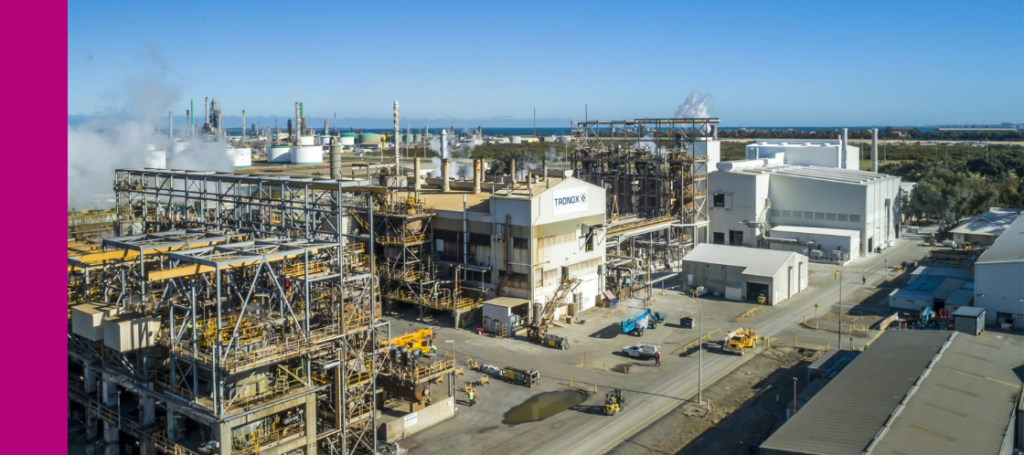
MGA Thermal has commenced a Front-End Engineering and Design (FEED) study for a 195 megawatt-hour electro-thermal energy storage project at Tronox’s Kwinana pigment plant in Western Australia, marking the next phase in what proponents describe as the country’s largest industrial thermal storage project.
The project is being developed by Australian company Knode and supported through a $2.95 million funding agreement with the Australian Renewable Energy Agency (ARENA), as part of a total project cost of $4.5 million.
If construction proceeds as planned in 2027, the system is expected to begin commercial operation in 2028, supplying around 20 tonnes of renewable steam per hour to Tronox through a Heat as a Service arrangement.
The project represents one of the clearest signs yet that technology developed locally may be moving beyond demonstration scale and into continuous industrial operations.
MGA Thermal’s energy storage system uses renewable electricity to generate heat, which is stored in proprietary MGA Blocks and later released to provide industrial steam on demand. The approach is designed to allow industrial facilities to continue operating using renewable electricity without relying on fossil fuel backup systems.
Replacing ageing gas infrastructure
According to ARENA, Tronox identified thermal energy storage as the preferred option for reducing reliance on its gas cogeneration plant at Kwinana, which is nearing the end of its approximately 30-year operating life.
The FEED study will examine the viability of deploying a 195 MWh thermal energy storage system capable of replacing steam currently produced by the ageing plant.
Project information from ARENA states the existing cogeneration system emits around 38,000 tonnes of carbon dioxide annually. If successful, the thermal energy storage system is expected to reduce emissions by approximately 32,000 tonnes a year, with further reductions possible through additional installations replacing gas boilers at the site.
The Kwinana project is also being watched as a potential model for wider use of thermal storage technology at other industrial sites.
Knode CEO Chris Nelson said moving to the FEED stage demonstrated a practical pathway for industrial decarbonisation.
“Progressing to the FEED stage is incredibly important, not just for our project with MGA Thermal, but for the fact that it demonstrates a viable way to electrify heavy industry. Keeping industries like mineral processing, refining, and materials manufacturing in Western Australia is going to be highly dependent on being able to decarbonise economically.”
Building on earlier testing
The Kwinana development is much larger than MGA Thermal’s demonstration plant, which was supported by ARENA and Shell and built to test the company’s technology across different industrial uses including process heat, dispatchable electricity and hydrogen production.
That demonstration system stores 5 MWh of thermal energy and includes about 3,700 MGA Blocks.
MGA Thermal’s technology itself emerged from almost a decade of research and development at the University of Newcastle before the company was founded in 2019.
A wider industrial pipeline
The Kwinana project is the first of several industrial developments MGA Thermal says it is progressing through FEED studies.
Earlier this year, ARENA committed $3.25 million to support up to five FEED studies involving deployment of the company’s thermal energy storage systems, with the aim of moving projects toward investment-ready status.
MGA Thermal chief executive officer Mark Croudace said the latest study marked the point where project planning moves closer to construction.
“Commencing the FEED study is a significant step — it’s where engineering challenges are resolved, and the pathway to FID and construction becomes real. This project is the first of several we are actively developing, and it demonstrates that MGA Thermal’s technology is ready to scale across industrial and manufacturing sectors.”