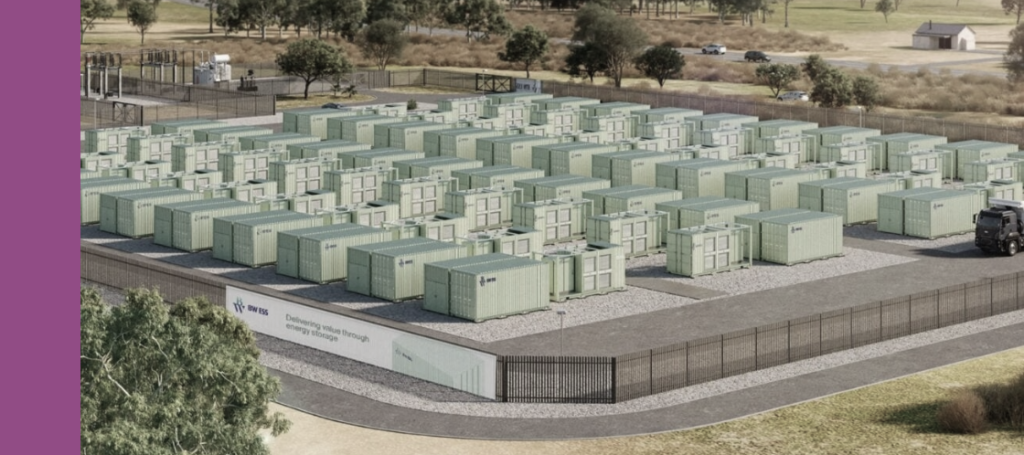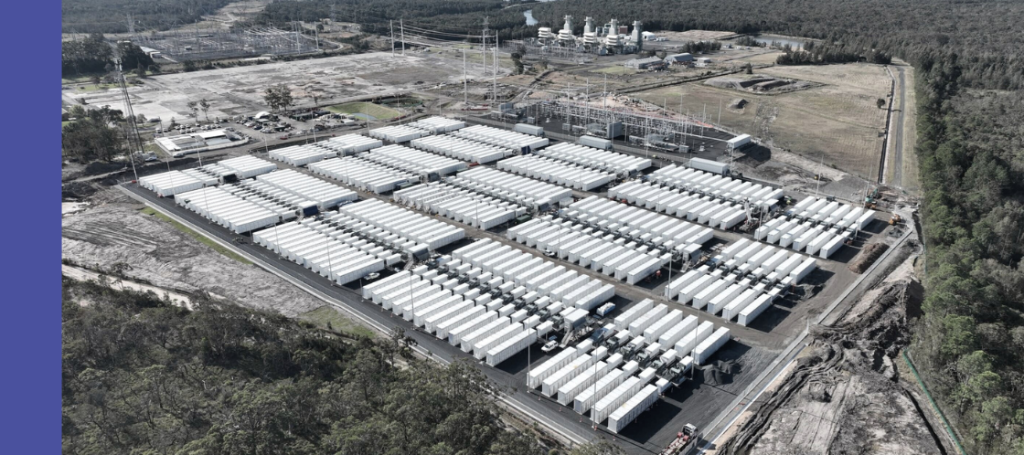
The Waratah Super Battery is now online in partial operation, with half of its planned 850 megawatts (MW) capacity connected to the NSW grid. The project has already demonstrated record performance during testing, confirming its role as the largest and most flexible battery energy storage system in the country.
Located on the Central Coast at the site of the former Munmorah coal-fired power station, the battery is designed to act as a system integrity protection scheme (SIPS). In practice, this means it will act as a “shock absorber” when major transmission lines are disrupted by events such as lightning strikes or bushfires.
So far, 350 MW (700 megawatt-hours) has been switched on, with the remaining capacity expected later this year. The project also includes a control system and upgrades to the state’s existing transmission network to ensure faster response to outages.
During recent testing, the battery injected up to 708 MW into the grid and then rapidly switched to charging at the same rate just minutes later, according to Renew Economy.
This level of flexibility allows the Waratah system to quickly change from being the largest supplier in the grid to one of the largest loads. Industry observers note that this capability will be central to managing a system with increasing amounts of wind and solar generation.
NSW Minister for Climate Change and Energy Penny Sharpe said, “The Waratah Super Battery is one of the biggest in the world, and a crucial addition to our energy system. As it comes online, it will help power our homes and businesses while stabilising the grid to avoid blackouts.”
The project is overseen by EnergyCo, with Akaysha Energy operating the battery system and Transgrid responsible for transmission upgrades.
“Bringing the first 350 megawatts of the Waratah Super Battery online is a major milestone and a moment of real pride for everyone at Akaysha Energy,” said Akaysha Energy CEO, Nick Carter
“This achievement is the result of a tremendous collective effort spanning our global business units across all areas such as delivery, engineering, commercial and legal, technical integration, grid modelling, software, operations and trading.”
Work to date has included upgrades at 22 substations and four transmission lines across NSW, along with the installation of what Transgrid describes as the largest SIPS Control System in the country.
Around 1,000 people have worked on the project during design and construction, including about 100 local workers from the Central Coast and Newcastle.
Once fully operational, the Waratah Super Battery will be able to provide 850 MW and 1,680 megawatt-hours, making it the most powerful grid-connected battery in the world. It is expected to remain in this role until the Hunter Transmission Project delivers new capacity from inland renewable energy zones later in the decade.