A proposed commercial-scale battery recycling plant in the Hunter is moving through its development work as Renewable Metals tests the technology and plant design intended to underpin the facility.
The Australian Renewable Energy Agency (ARENA)’s current project record for Renewable Metals’ Commercial Prototype for Recycling Critical Minerals from Batteries says the project will directly support Front End Engineering and Design, known as FEED, and a Final Investment Decision for the proposed Hunter plant.
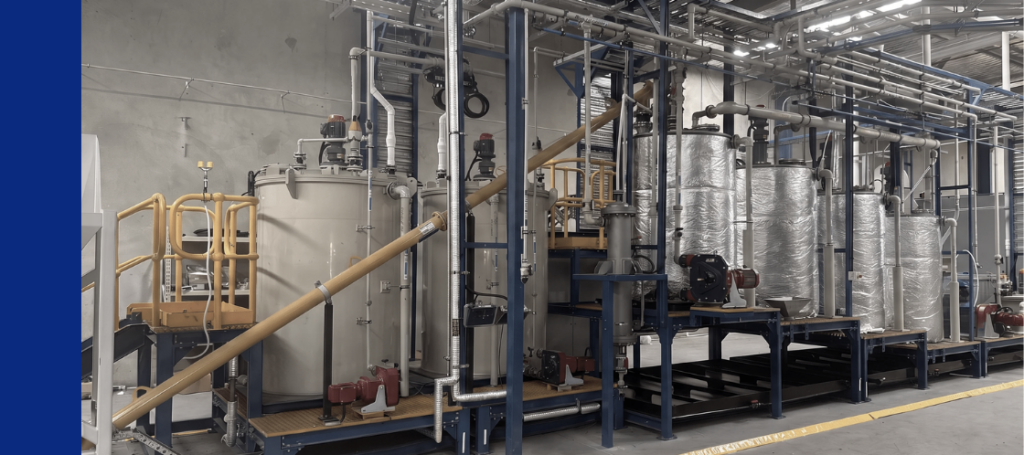
The work is being carried out at Renewable Metals’ existing hydrometallurgical facility at Kewdale in Western Australia, where the company is demonstrating its process for recovering critical minerals from end-of-life lithium-ion batteries.
Renewable Metals said in April that its first commercial-scale facility was planned for the Hunter, with its $12 million Series A capital raising helping fund continuous prototype operations and engineering design for the proposed plant.
Recycling full battery packs
The ARENA-backed project will initially add equipment including a module shredder with a throughput of 960 tonnes a year, an electrowinning circuit and other upgrades to the Kewdale processing line.
A commercial-scale pack shredder will then be installed and operated with capacity to process 2,000 tonnes a year, allowing the facility to handle full electric vehicle battery packs and battery energy storage systems.
The project is intended to demonstrate Renewable Metals’ modular plant design and its ability to produce saleable metals and metal salts from different lithium-ion battery chemistries and formats.
Renewable Metals has developed an alkali-based hydrometallurgical process designed to recover lithium, cobalt, nickel, copper and manganese from end-of-life batteries.
The company said its process could handle different lithium-ion battery chemistries on the same processing line, including nickel manganese cobalt and lithium iron phosphate batteries, as well as different forms of battery material ranging from production scrap to complete packs.
Keeping more battery materials onshore
ARENA said Australia currently exports nearly all of the end-of-life lithium-ion batteries it processes as lower-value black mass to China for further processing.
The agency said developing domestic recycling and refining capacity could retain more of the economic value associated with recovered battery materials in Australia while building local skills and reducing reliance on offshore processing.
Renewable Metals chief executive Luan Atkinson said the company’s approach was designed to allow recycling plants to be built at a scale appropriate to available battery waste rather than relying on very large centralised facilities.
“Our process changes the economics of battery recycling. By delivering high recovery at low cost without large, centralised facilities, we can build plants sized for near term feedstock, and scale with the market over time.”
The Kewdale project will also collect operational and economic data intended to inform the engineering design of the proposed Hunter facility.
Hunter proposal has been under development
The Hunter plant is not a new proposal.
Renewable Metals and AGL announced a Memorandum of Understanding in December 2023 to investigate establishing a lithium battery recycling facility at AGL’s Hunter Energy Hub.
At that stage, the companies said a pre-feasibility study would examine infrastructure and engineering requirements as well as the regulatory approvals and licences that would be required to develop and operate the facility.
The proposed facility was then envisaged with an initial capacity of 5,000 tonnes a year.
Renewable Metals said in April 2026 that its Series A funding would accelerate FEED for its first commercial facility in the Hunter.
The more recent ARENA project record establishes a further connection between the company’s work in Western Australia and the Hunter proposal, with the prototype project intended to support both FEED and the eventual investment decision for the commercial plant.